Wednesday, May 13, 2020

Structural basis for the inhibition of SARS-CoV-2 main protease by antineoplastic drug carmofur

Zhenming Jin, Yao Zhao, Yuan Sun, Bing Zhang, Haofeng Wang, Yan Wu, Yan Zhu, Chen Zhu, Tianyu Hu, Xiaoyu Du, Yinkai Duan, Jing Yu, Xiaobao Yang, Xiuna Yang, Kailin Yang, Xiang Liu, Luke W. Guddat, Gengfu Xiao, Leike Zhang, Haitao Yang & Zihe Rao

Nat Struct Mol Biol, 2020
https://doi.org/10.1038/s41594-020-0440-6


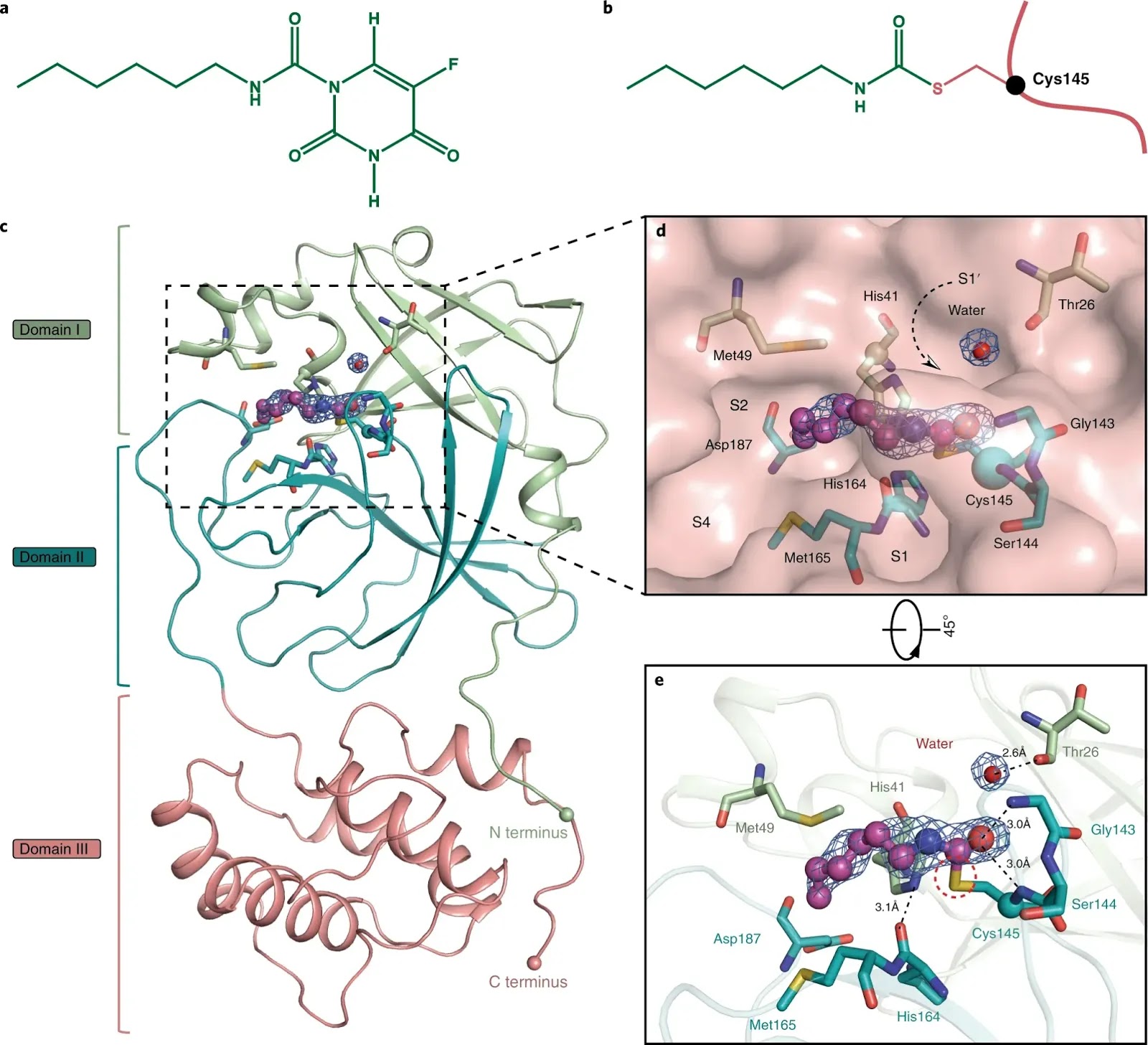
The antineoplastic drug carmofur is shown to inhibit the SARS-CoV-2 main protease (Mpro). Here, the X-ray crystal structure of Mpro in complex with carmofur reveals that the carbonyl reactive group of carmofur is covalently bound to catalytic Cys145, whereas its fatty acid tail occupies the hydrophobic S2 subsite. Carmofur inhibits viral replication in cells (EC50 = 24.30 μM) and is a promising lead compound to develop new antiviral treatment for COVID-19. 

Covalent Targeting of Ras G12C by Rationally Designed Peptidomimetics

Daniel Y Yoo, Andrew D. Hauser, Stephen T Joy, Dafna Bar-Sagi, and Paramjit S. Arora
ACS Chemical Biology 2020
DOI: 10.1021/acschembio.0c00204

Protein-protein interactions (PPIs) play a critical role in fundamental biological processes. Competitive inhibition of these interfaces requires compounds that can access discontinuous binding epitopes along a large, shallow binding surface area. Conformationally- defined protein surface mimics present a viable route to target these interactions. However, the development of minimal protein mimics that engage intracellular targets with high affinity remains a major challenge because mimicry of a portion of the binding interface is often associated with the loss of critical binding interactions. Covalent targeting provides an attractive approach to overcome the loss of non-covalent contacts but have the inherent risk of dominating non-covalent contacts and increasing the likelihood of non-selective binding. Here, we report the iterative design of a proteolytically-stable helix mimic that covalently targets oncogenic G12C Ras as a model system. We explored several electrophiles to optimize preferential alkylation with the desired C12 on Ras. The designed lead peptide modulates nucleotide exchange, inhibits activation of the Ras-mediated signalling cascade, and is selectively toxic towards mutant G12C Ras cancer cells. The relatively high frequency of acquired cysteines as missense mutations in cancer and other diseases suggests that covalent peptides may offer an untapped therapeutic approach for targeting aberrant protein interactions.

Tuesday, May 12, 2020

An Azidoribose Probe to Track Ketoamine Adducts in Histone Ribose Glycation [@David_Lab_MSK]

Igor Maksimovic, Qingfei Zheng, Marissa N. Trujillo, James J. Galligan, and Yael David
Journal of the American Chemical Society 2020
DOI: 10.1021/jacs.0c01325

Reactive cellular metabolites can modify macromolecules and form adducts known as non-enzymatic covalent modifications (NECMs). Dissecting the mechanisms, regulation and consequences of NECMs, such as glycation, has been challenging due to the complex and often ambiguous nature of the adducts formed. Directly tracking the formation of modifications on key targets to uncover their underlying physiological importance requires specific chemical tools. Here we present the novel chemoenzymatic syntheses of an active azido-modified ribose analog, 5-azidoribose (5-AR), as well as an inactive control derivative, 1-azidoribose (1-AR) and their application towards understanding protein ribose-glycation in vitro and in cellulo. With these new probes we found that, similar to MGO-glycation, ribose glycation specifically accumulates on histones. In addition to fluorescent labeling, we demonstrate the utility of the probe in enriching modified targets, which were identified by label-free quantitative proteomics and high-resolution MS/MS workflows. Finally, we establish that the known oncoprotein and hexose deglycase, fructosamine 3-kinase (FN3K), recognizes and facilitates the removal of 5-AR glycation adducts in live cells, supporting the dynamic regulation of ribose glycation as well as validating the probe as a new chemical tool to monitor FN3K activity. Altogether, we demonstrate this probe’s utilities to uncover ribose-glycation and deglycation events as well as tracking FN3K activity towards establishing its potential as a new cancer vulnerability.

Reactive Sterol Electrophiles: Mechanisms of Formation and Reactions with Proteins and Amino Acid Nucleophiles

Ned A. Porter, Libin Xu,  and Derek A. Pratt
Chemistry 2020, 2(2), 390-417
https://doi.org/10.3390/chemistry2020025

Radical-mediated lipid oxidation and the formation of lipid hydroperoxides has been a focal point in the investigation of a number of human pathologies. Lipid peroxidation has long been linked to the inflammatory response and more recently, has been identified as the central tenet of the oxidative cell death mechanism known as ferroptosis. The formation of lipid electrophile-protein adducts has been associated with many of the disorders that involve perturbations of the cellular redox status, but the identities of adducted proteins and the effects of adduction on protein function are mostly unknown. Both cholesterol and 7-dehydrocholesterol (7-DHC), which is the immediate biosynthetic precursor to cholesterol, are oxidizable by species such as ozone and oxygen-centered free radicals. Product mixtures from radical chain processes are particularly complex, with recent studies having expanded the sets of electrophilic compounds formed. Here, we describe recent developments related to the formation of sterol-derived electrophiles and the adduction of these electrophiles to proteins. A framework for understanding sterol peroxidation mechanisms, which has significantly advanced in recent years, as well as the methods for the study of sterol electrophile-protein adduction, are presented in this review.

Sunday, May 10, 2020

A novel USP30 inhibitor recapitulates genetic loss of USP30 and sets the trigger for PINK1-PARKIN amplification of mitochondrial ubiquitylation

Emma Rusilowicz-Jones, Jane Jardine, Andreas Kallinos, Adan Pinto-Fernandez, Franziska Guenther, Mariacarmela Giurrandino, Francesco G. Barone, Katy McCarron, Christopher J. Burke, Alejandro Murad, Aitor Martinez, Elena Marcassa, Malte Gersch, Alex Buckmelter, Katherine J. Kayser-Bricker, Frederic Lamoliatte, Akshada Gajbhiye, Simon Davis, Hannah C. Scott, Emma Murphy, Katherine England,  Heather Mortiboys,  David Komander, Matthias Trost,  Benedikt M. Kessler, Stephanos Ioannidis, Michael Ahlijanian,  Sylvie Urbé,  Michael J. Clague

BioRxiv, 2020
doi: https://doi.org/10.1101/2020.04.16.044206

The mitochondrial deubiquitylase USP30 negatively regulates the selective autophagy of damaged mitochondria. It has been proposed as an actionable target to alleviate the loss of function of the mitophagy pathway governed by the Parkinson’s Disease associated genes PINK1 and PRKN. We present the characterisation of a N-cyano pyrrolidine derived compound, FT3967385, with high selectivity for USP30. The compound is well tolerated with no loss of total mitochondrial mass. We demonstrate that ubiquitylation of TOM20, a component of the outer mitochondrial membrane import machinery that directly interacts with USP30, represents a robust biomarker for both USP30 loss and inhibition. We have conducted proteomics analyses on a SHSY5Y neuroblastoma cell line model to directly compare the effects of genetic loss of USP30 with selective inhibition in an unbiased fashion. We have thereby identified a subset of ubiquitylation events consequent to mitochondrial depolarisation that are USP30 sensitive. Within responsive elements of the ubiquitylome, several components of the outer mitochondrial membrane transport (TOM) complex are most prominent. Thus, our data support a model whereby USP30 can regulate the availability of ubiquitin at the specific site of mitochondrial PINK1 accumulation following membrane depolarisation. In this model, USP30 deubiquitylation of TOM complex components dampens the trigger for the Parkin-dependent amplification of mitochondrial ubiquitylation leading to mitophagy. Accordingly, PINK1 generation of phospho-Ser65 Ubiquitin proceeds more rapidly and to a greater extent in cells either lacking USP30 or subject to USP30 inhibition.

Wednesday, May 6, 2020

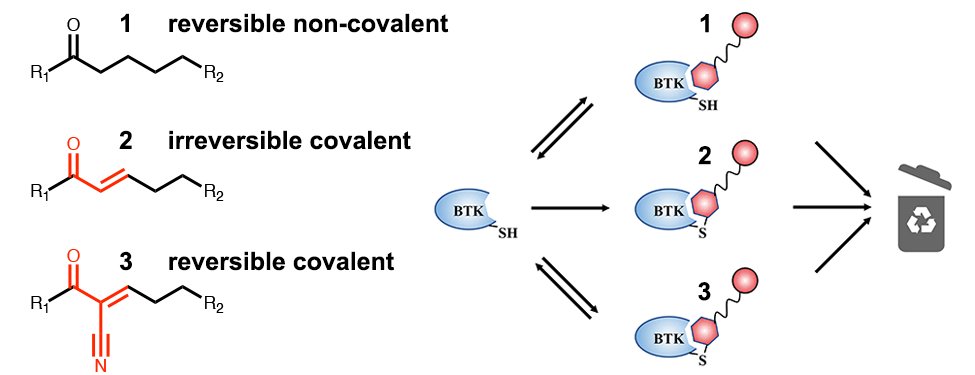
Efficient targeted degradation via reversible and irreversible covalent PROTACs [@london_lab]

Ronen Gabizon, Amit Shraga, Paul Gehrtz, Ella Livnah, Yamit Shorer, Neta Gurwicz, Liat Avram, Tamar Unger, Hila Aharoni, Shira Albeck, Alexander Brandis, Ziv shulman, Ben-Zion Katz, Yair Herishanu, and Nir London

Journal of the American Chemical Society, 2020
DOI: 10.1021/jacs.9b13907

PROteolysis Targeting Chimeras (PROTACs) represent an exciting inhibitory modality with many advantages, including sub-stoichiometric degradation of targets. Their scope, though, is still limited to-date by the requirement for a sufficiently potent target binder. A solution that proved useful in tackling challenging targets is the use of electrophiles to allow irreversible binding to the target. However, such binding will negate the catalytic nature of PROTACs. Reversible covalent PROTACs potentially offer the best of both worlds. They possess the potency and selectivity associated with the formation of the covalent bond, while being able to dissociate and regenerate once the protein target is degraded. Using Bruton’s tyrosine kinase (BTK) as a clinically relevant model system, we show efficient covalent degradation by non-covalent, irreversible covalent and reversible covalent PROTACs, with <10 nM DC50’s and >85% degradation. Our data suggests that part of the degradation by our irreversible covalent PROTACs is driven by reversible binding prior to covalent bond formation, while the reversible covalent PROTACs drive degradation primarily by covalent engagement. The PROTACs showed enhanced inhibition of B cell activation compared to Ibrutinib, and exhibit potent degradation of BTK in patients-derived primary chronic lymphocytic leukemia cells. The most potent reversible covalent PROTAC, RC-3, exhibited enhanced selectivity towards BTK compared to non-covalent and irreversible covalent PROTACs. These compounds may pave the way for the design of covalent PROTACs for a wide variety of challenging targets.

Saturday, May 2, 2020

Discovery of M-808 as a Highly Potent, Covalent, Small-Molecule Inhibitor of the Menin–MLL Interaction with Strong In Vivo Antitumor Activity

Shilin Xu, Angelo Aguilar, Liyue Huang, Tianfeng Xu, Ke Zheng, Donna McEachern, Sally Przybranowski, Caroline Foster, Kaitlin Zawacki, Zhaomin Liu, Krishnapriya Chinnaswamy, Jeanne Stuckey, and Shaomeng Wang

Journal of Medicinal Chemistry, 2020
DOI: 10.1021/acs.jmedchem.0c00547


Targeting the menin–MLL protein–protein interaction is a new therapeutic strategy for the treatment of acute leukemia carrying MLL fusion (MLL leukemia). We describe herein the structure-based optimization of a class of covalent menin inhibitors, which led to the discovery of M-808 (16) as a highly potent and efficacious covalent menin inhibitor. M-808 effectively inhibits leukemia cell growth at low nanomolar concentrations and is capable of achieving partial tumor regression in an MV4;11 xenograft tumor model in mice at a well-tolerated dose schedule. Determination of the co-crystal structure of M-808 in complex with menin provides a structural basis for their high-affinity, covalent interactions. M-808 represents a promising, covalent menin inhibitor for further optimization and evaluation toward developing a new therapy for the treatment of MLL leukemia.


Structure-Guided Design of a Brain-Penetrant Covalent Inhibitor of Human Butyrylcholinesterase with In Vivo Procognitive Efficacy

Peter Mastnak-Sokolov, Urban Košak, Anže Meden, Damijan Knez, Simon Žakelj, Selena Horvat, Anja Pišlar, Jakob Kljun, Alexandre Igert, Jo...