Saturday, January 11, 2020

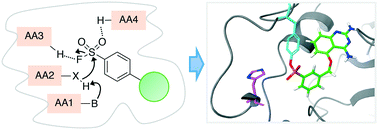
Structure-based design and analysis of SuFEx chemical probes

Lyn H. Jones and Jeffery W. Kelly

RSC Med. Chem., 2020
DOI: 10.1039/C9MD00542K
The discerning reactivity of sulfur(VI)-fluoride exchange (SuFEx) chemistry has enabled the context-specific labeling of protein binding sites by chemical probes that incorporate these versatile warheads. Emerging information from protein-probe structures and proteomic mapping experiments is helping advance our understanding of the protein microenvironment that dictates the reactivity of targetable amino acid residues. This review explores these new findings that should influence the future rational design of SuFEx probes for a multitude of applications in chemical biology and drug discovery.
Graphical abstract: Structure-based design and analysis of SuFEx chemical probes

Wednesday, January 8, 2020

Efficient targeted degradation via reversible and irreversible covalent PROTACs

Ronen Gabizon Amit Shraga Paul Gehrtz Ella Livnah Neta Gurwicz Liat Avram Tamar Unger Shira Albeck Ziv Shulman Nir London

ChemRxiv, 2020
DOI: 10.26434/chemrxiv.11494398.v1

PROteolysis Targeting Chimeras (PROTACs) represent an exciting inhibitory modality with many advantages, including sub-stoichiometric degradation of targets. Their scope, though, is still limited to-date by the requirement for a sufficiently potent target binder. A solution that proved useful in tackling challenging targets is the use of electrophiles to allow irreversible binding to the target. However, such binding will negate the catalytic nature of PROTACs. Reversible covalent PROTACs offer the best of both worlds. They possess the potency and selectivity associated with the formation of the covalent bond, while being able to dissociate and regenerate once the protein target is degraded. Using Bruton’s tyrosine kinase (BTK) as a clinically relevant model system, we present a proof-of concept for the first in class cyanoacrylamide reversible covalent PROTACs. We show efficient degradation with reversible covalent PROTACs, as well as their non-covalent and irreversible counterparts. The latter are amongst the most efficient PROTACs reported for BTK. They display single digit nM DC50, full degradation within 2-4 hours, proteome wide selectivity and show ~10-fold better inhibition of B cell activation than Ibrutinib. These examples refute the notion that covalent binders are not suitable as the basis for PROTACs, and may pave the way for the design of covalent PROTACs for a wide variety of challenging targets.

Sunday, January 5, 2020

Tunable heteroaromatic sulfones enhance in-cell cysteine profiling

Hashim F Motiwala, Yu-Hsuan Kuo, Brittany L. Stinger, Bruce A. Palfey, and Brent R. Martin
Journal of the American Chemical Society 2020
DOI: 10.1021/jacs.9b08831

Heteroaromatic sulfones react with cysteine via nucleophilic aromatic substitution, providing a mechanistically selective and irreversible scaffold for cysteine conjugation. Here we evaluate a library of heteroaromatic sulfides with different oxidation states, heteroatom substitutions, and a series of electron donating and electron-withdrawing substituents. Select substitutions profoundly influence reactivity and stability compared to conventional cysteine conjugation reagents, increasing the reaction rate by >3-orders of magnitude. The findings establish a series of synthetically accessible electrophilic scaffolds tunable across multiple tunable centers. New electrophiles and their corresponding alkyne-conjugates were profiled directly in cultured cells, achieving thiol saturation in a few minutes at sub-millimolar concentrations. Direct addition of desthiobiotin-functionalized probes to cultured cells simplified enrichment and elution to enable mass spectrometry discovery of >3000 reactive and/or accessible thiols labeled in their native cellular environments in a fraction of the standard analysis time. Surprisingly, only 1/2 of annotated cysteines were identified by both iodoacetamide-desthiobiotin and methylsulfonylbenzothiazole-desthiobiotin in replicate experiments, demonstrating complementary detection by mass spectrometry analysis. These probes offer advantages over existing cysteine alkylation reagents, including accelerated reaction rates, improved stability, and robust ionization for mass spectrometry applications. Overall, heteroaromatic sulfones provide modular tunability, shifted chromatographic elution times, and superior in-cell cysteine profiling for in-depth proteome-wide analysis and covalent ligand discovery.

Friday, January 3, 2020

Enhancing Intracellular Concentration and Target Engagement of PROTACs with Reversible Covalent Chemistry

Wen-Hao Guo, Xiaoli Qi, Yang Liu, Chan-I Chung, Fang Bai, Xingcheng Lin, Lingfei Wang, Jianwei Chen, Krystle J. Nomie, Feng Li, Meng C. Wang, Xiaokun Shu, José N. Onuchic, Jennifer A. Woyach, Michael L. Wang, Jin Wang

bioRxiv 2019

Current efforts in the proteolysis targeting chimera (PROTAC) field mostly focus on choosing the appropriate E3 ligase for a certain targeted protein, improving the binding affinities towards the target protein and the E3 ligase, and optimizing the PROTAC linker. However, it is well known that due to the large sizes of PROTAC molecules, their cellular uptake level remains an issue, posing a challenge to translate PROTACs into therapeutics. Driven by our fundamental investigation to compare how different warhead chemistry, reversible noncovalent (RNC), reversible covalent (RC), and irreversible covalent (IRC) binders, may affect the degradation of a model protein Bruton’s Tyrosine Kinase (BTK), we serendipitously discovered that cyano-acrylamide-based reversible covalent chemistry can significantly enhance the intracellular concentration and target engagement of the PROTAC. Building on this discovery, we developed RC-1 as the first reversible covalent BTK PROTAC, which has high target occupancy and is effective as both an inhibitor and a degrader. Molecular dynamics calculations and phase-separation based ternary complex assays support that RC-1 forms a stable ternary complex with BTK and Cereblon (CRBN). Additionally, RC-1 compares favorably with other reported BTK degraders in cell viability and target engagement assays and has a reasonable plasma half-life for in vivo applications. Importantly, this reversible covalent strategy can be generalized and applied to improve other PROTACs. This work can not only help to develop optimal BTK degraders for clinical applications but also provide a new strategy to improve PROTAC efficacy.

Thursday, January 2, 2020

Catalytic Mechanism and Covalent Inhibition of UDP-N-Acetylglucosamine Enolpyruvyl Transferase (MurA): Implications to the Design of Novel Antibacterials

Levente M. Mihalovits, György G. Ferenczy, and György M. Keserű
Journal of Chemical Information and Modeling 2019 59 (12), 5161-5173
DOI: 10.1021/acs.jcim.9b00691

UDP-N-acetylglucosamine enolpyruvyl transferase (MurA) catalyzes the first step in the biosynthesis of the bacterial cell wall. This pathway is essential for the growth of bacteria but missing in mammals, that nominates MurA as an attractive antibacterial target. MurA has a flexible loop whose conformational change is known to be part of the activation mechanism of the enzyme. We have shown that the loop closed conformation makes the proton transfer from Cys115 to His394 possible by a low barrier exothermic process. QM/MM MD simulations revealed that the activated thiolate is able to react with phosphoenolpyruvate (PEP), the natural substrate of MurA. The binding free energy profile of several covalent inhibitors with various warheads reacting with the activated Cys115 was calculated by QM/MM MD simulations and confirmed that reaction barrier heights tend to separate active from inactive compounds. Our results give new insight into the catalytic mechanism and covalent inhibition of MurA and suggest that QM/MM MD simulations are able to support ligand design by providing sensible relative free energy barriers for covalent inhibitors with various warheads reacting with thiolate nucleophiles.

Sunday, December 29, 2019

Exploring Targeted Degradation Strategy for Oncogenic KRASG12C

Mei Zeng, Yuan Xiong, Nozhat Safaee, Radoslaw P. Nowak, Katherine A. Donovan, Christine J. Yuan, Behnam Nabet, Thomas W. Gero, Frederic Feru, Lianbo Li, Sudershan Gondi, Lincoln J. Ombelets, Chunshan Quan, Pasi A. Jänne, Milka Kostic, David A. Scott, Kenneth D. Westover, Eric S. Fischer Nathanael S. Gray

Cell Chemical Biology, 2019


KRAS is the most frequently mutated oncogene found in pancreatic, colorectal, and lung cancers. Although it has been challenging to identify targeted therapies for cancers harboring KRAS mutations, KRAS G12C can be targeted by small-molecule inhibitors that form covalent bonds with cysteine 12 (C12). Here, we designed a library of C12-directed covalent degrader molecules (PROTACs) and subjected them to a rigorous evaluation process to rapidly identify a lead compound. Our lead degrader successfully engaged CRBN in cells, bound KRAS G12C in vitro, induced CRBN/KRAS G12C dimerization, and degraded GFP-KRAS G12C in reporter cells in a CRBN-dependent manner. However, it failed to degrade endogenous KRAS G12C in pancreatic and lung cancer cells. Our data suggest that inability of the lead degrader to effectively poly-ubiquitinate endogenous KRAS G12C underlies the lack of activity. We discuss challenges for achieving targeted KRAS G12C degradation and proposed several possible solutions which may lead to efficient degradation of endogenous KRAS G12C.

Sunday, December 22, 2019

A chemical proteomic probe for the mitochondrial pyruvate carrier complex

Yamashita, Y., Vinogradova, E., Zhang, X., Suciu, R. and Cravatt, B.

Angew. Chem. Int. Ed.. 2019 
doi:10.1002/anie.201914391

Target engagement assays are crucial for establishing the mechanism‐of‐action of small molecules in living systems. Integral membrane transporters, due to their specialized biophysical properties and activity assays, can present a challenging protein class for assessing cellular engagement by small molecules. Here, we describe the chemical proteomic discovery of alpha‐chloroacetamide (aCA) compounds that covalently modify cysteine‐54 (C54) of the MPC2 subunit of the mitochondrial pyruvate carrier (MPC) complex. We leverage this finding to create an alkyne‐modified aCA, YY4‐yne, that serves as a versatile cellular target engagement probe for MPC2 in click chemistry‐enabled western blotting or global mass spectrometry‐based proteomic experiments. Using YY4‐yne, we demonstrate that UK‐5099, an alpha‐cyanocinnamate inhibitor of the MPC complex, first discovered more than 30 years ago, but still with a poorly defined mechanism‐of‐action, engages MPC2 with remarkable selectivity in human cells. These findings support a model where UK‐5099 inhibits the MPC complex by binding to C54 of MPC2 in a covalent reversible manner that can be quantified in cells using the YY4‐yne probe.

Fragment-Based Covalent Targeting of Lysines at the Allosteric Latch Site of SHP2.

  Vincenzo Di Lorenzo , Noémi Csorba , Renáta Szabó , Levente Kollár , Yvette Roske , Ivan Rand̵elović , Krisztina Balázs , Tibor Vikt...