Monday, May 2, 2022

In situ identification of cellular drug targets in mammalian tissue

 Zhengyuan Pang, Michael A. Schafroth, Daisuke Ogasawara, Yu Wang, Victoria Nudell, Neeraj K. Lal, Dong Yang, Kristina Wang, Dylan M. Herbst, Jacquelyn Ha, Carlos Guijas, Jacqueline L. Blankman, Benjamin F. Cravatt, Li Ye,

Cell 2022

https://doi.org/10.1016/j.cell.2022.03.040

The lack of tools to observe drug-target interactions at cellular resolution in intact tissue has been a major barrier to understanding in vivo drug actions. Here, we develop clearing-assisted tissue click chemistry (CATCH) to optically image covalent drug targets in intact mammalian tissues. CATCH permits specific and robust in situ fluorescence imaging of target-bound drug molecules at subcellular resolution and enables the identification of target cell types. Using well-established inhibitors of endocannabinoid hydrolases and monoamine oxidases, direct or competitive CATCH not only reveals distinct anatomical distributions and predominant cell targets of different drug compounds in the mouse brain but also uncovers unexpected differences in drug engagement across and within brain regions, reflecting rare cell types, as well as dose-dependent target shifts across tissue, cellular, and subcellular compartments that are not accessible by conventional methods. CATCH represents a valuable platform for visualizing in vivo interactions of small molecules in tissue.

Keywords: drug target engagement; drug distribution; molecular imaging; click chemistry; target identification; covalent inhibitor


Wednesday, April 27, 2022

Covalent narlaprevir- and boceprevir-derived hybrid inhibitors of SARS-CoV-2 main protease

Kneller, D.W., Li, H., Phillips, G. et al. 

Nat Commun 13, 2268 (2022). 

https://doi.org/10.1038/s41467-022-29915-z

Emerging SARS-CoV-2 variants continue to threaten the effectiveness of COVID-19 vaccines, and small-molecule antivirals can provide an important therapeutic treatment option. The viral main protease (Mpro) is critical for virus replication and thus is considered an attractive drug target. We performed the design and characterization of three covalent hybrid inhibitors BBH-1, BBH-2 and NBH-2 created by splicing components of hepatitis C protease inhibitors boceprevir and narlaprevir, and known SARS-CoV-1 protease inhibitors. A joint X-ray/neutron structure of the Mpro/BBH-1 complex demonstrates that a Cys145 thiolate reaction with the inhibitor’s keto-warhead creates a negatively charged oxyanion. Protonation states of the ionizable residues in the Mpro active site adapt to the inhibitor, which appears to be an intrinsic property of Mpro. Structural comparisons of the hybrid inhibitors with PF-07321332 reveal unconventional F···O interactions of PF-07321332 with Mpro which may explain its more favorable enthalpy of binding. BBH-1, BBH-2 and NBH-2 exhibit comparable antiviral properties in vitro relative to PF-07321332, making them good candidates for further design of improved antivirals.


Intracellular Formation of a DNA Damage-Induced, Histone Post-Translational Modification Following Bleomycin Treatment

Marco Paolo Jacinto, Stephen D. Fried, and Marc M. Greenberg
Journal of the American Chemical Society Article ASAP

DOI: 10.1021/jacs.2c02880

Evaluating the significance of various forms of DNA damage is complicated by discoveries that some lesions inactivate repair enzymes or produce more deleterious forms of damage. Histone lysines within nucleosomes react with the commonly produced C4′-oxidized abasic site (C4-AP) to concomitantly yield an electrophilic modification (KMP) on lysine and DNA strand scission. We developed a chemoproteomic approach to identify KMP in HeLa cells. More than 60 000 KMP-modified histones are produced per cell. Using LC-MS/MS, we detected KMP at 17 of the 57 lysine residues distributed throughout the four core histone proteins. Therefore, KMP constitutes a DNA damage-induced, nonenzymatic histone post-translational modification. KMP formation suggests that downstream processes resulting from DNA damage could have ramifications on cells.


Conditional covalent lethality driven by oncometabolite accumulation

Minervo Perez, Kellie D Nance, Daniel W Bak, Supuni Thalalla Gamage, Susana S Najera, Amy N Conte, W. Marston Linehan, Eranthie Weerapana, Jordan L Meier

bioRxiv 2022.04.26.489575; 

doi: https://doi.org/10.1101/2022.04.26.489575

Hereditary leiomyomatosis and renal cell carcinoma (HLRCC) is a cancer predisposition syndrome driven by mutation of the tumor suppressor fumarate hydratase (FH). Inactivation of FH causes accumulation of the electrophilic oncometabolite fumarate. In the absence of methods for reactivation, tumor suppressors can be targeted via identification of synthetic lethal interactions using genetic screens. Inspired by recent advances in chemoproteomic target identification, here we test the hypothesis that the electrophilicity of the HLRCC metabolome may produce unique susceptibilities to covalent small molecules, a phenomenon we term conditional covalent lethality. Screening a panel of chemically diverse electrophiles we identified a covalent ligand, MP-1, that exhibits FH-dependent cytotoxicity. Synthesis and structure-activity profiling identified key molecular determinants underlying the molecule's effects. Chemoproteomic profiling of cysteine reactivity together with clickable probes validated the ability of MP-1 to engage an array of functional cysteines, including one lying in the Zn-finger domain of the tRNA methyltransferase enzyme TRMT1. TRMT1 overexpression rescues tRNA methylation from inhibition by MP-1 and partially attenuates the covalent ligand's cytotoxicity. Our studies highlight the potential for covalent metabolites and small molecules to synergistically produce novel synthetic lethal interactions and raise the possibility of applying phenotypic screening with chemoproteomic target identification to identify new functional oncometabolite targets.

Thursday, April 21, 2022

Cell-Active, Reversible, and Irreversible Covalent Inhibitors that Selectively Target the Catalytic Lysine of BCR-ABL Kinase

Chen, P., Sun, J., Zhu, C., Tang, G., Wang, W., Xu, M., Xiang, M., Zhang, C., Zhang, Z., Gao, L. and Yao, S..Q. 

Angew. Chem. Int. Ed. 2022

https://doi.org/10.1002/anie.202203878

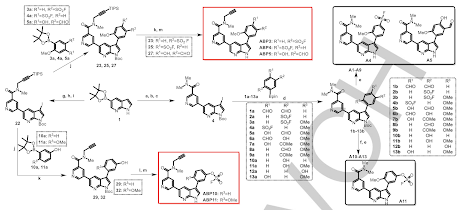
Despite recent interests in developing lysine-targeting covalent inhibitors, no general approach is available to create such compounds. We report herein a general approach to develop cell-active covalent inhibitors of protein kinases by targeting the conserved catalytic lysine residue using key SuFEx and salicylaldehyde-based imine chemistries. We validated the strategy by successfully developing (irreversible and reversible) covalent inhibitors against BCR-ABL kinase. Our lead compounds showed high levels of selectivity in biochemical assays, exhibited nanomolar potency against endogenous ABL kinase in cellular assays, and were active against most drug-resistant ABL mutations. Among them, the salicylaldehyde-containing A5 is the first-ever reversible covalent ABL inhibitor that possessed time-dependent ABL inhibition with prolonged residence time and few cellular off-targets in K562 cells. Bioinformatics further suggested the generality of our strategy against the human kinome.

Friday, April 15, 2022

Discovery, Preclinical Characterization, and Early Clinical Activity of JDQ443, a Structurally Novel, Potent and Selective, Covalent Oral Inhibitor of KRASG12C

Andreas Weiss1*, Edwige Lorthiois1*, Louise Barys1, Kim S. Beyer1, Claudio Bomio-Confaglia1, Heather Burks2, Xueying Chen3, Xiaoming Cui3, Ruben de Kanter1, Lekshmi Dharmarajan1, Carmine Fedele2, Marc Gerspacher1, Daniel Alexander Guthy1, Victoria Head 1, Ashley Jaeger2, Eloísa Jiménez Núñez 1, Jeffrey D Kearns2, Catherine Leblanc1, Sauveur-Michel Maira1, Jason Murphy2, Helen Oakman2, Nils Ostermann1, Johannes Ottl1, Pascal Rigollier1, Danielle Roman1, Christian Schnell1, Richard Sedrani1, Toshio Shimizu4, Rowan Stringer1, Andrea Vaupel1, Hans Voshol1, Peter Wessels5, Toni Widmer5, Rainer Wilcken1, Kun Xu3, Frederic Zecri2, Anna F. Farago2#, Simona Cotesta1# and Saskia M. Brachmann


Cancer Discov
 candisc.0158.2022.

Covalent inhibitors of KRASG12C have shown antitumor activity against advanced/metastatic KRAS 46 G12C-mutated cancers, though resistance emerges and additional strategies are needed to improve 47 outcomes. JDQ443 is a structurally unique, covalent inhibitor of GDP-bound KRASG12C that forms 48 novel interactions with the switch II pocket. JDQ443 potently inhibits KRASG12C-driven cellular 49 signaling and demonstrates selective antiproliferative activity in KRAS G12C-mutated cell lines, 50 including those with G12C/H95 double mutations. In vivo, JDQ443 induces AUC exposure-driven 51 antitumor efficacy in KRAS G12C-mutated cell-derived (CDX) and patient-derived (PDX) tumor 52 xenografts. In PDX models, single-agent JDQ443 activity is enhanced by combination with SHP2, 53 MEK or CDK4/6 inhibitors. Notably, the benefit of JDQ443 plus the SHP2 inhibitor TNO155 is 54 maintained at reduced doses of either agent in CDX models, consistent with mechanistic synergy. 55 JDQ443 is in clinical development as monotherapy and in combination with TNO155, with both 56 strategies showing antitumor activity in patients with KRAS G12C-mutated tumors.   


Monday, March 28, 2022

Discovery of SPH5030, a Selective, Potent, and Irreversible Tyrosine Kinase Inhibitor for HER2-Amplified and HER2-Mutant Cancer Treatment

Di Li, Yuanxiang Tu, Kaijun Jin, Lingjun Duan, Yuan Hong, Jia Xu, Na Chen, Zhihui Zhang, Hongjian Zuo, Wanchun Gong, Jing Zhang, Qian Wang, Hai Qian, Xuenan Wang, Ying Ke, and Guangxin Xia
Journal of Medicinal Chemistry 2022

DOI: 10.1021/acs.jmedchem.1c00710

Small-molecule irreversible tyrosine kinase inhibitors as high potent agents have led to improvements in disease-free and overall survival in patients with HER2-amplified cancer. The approved irreversible HER2 inhibitors, neratinib and pyrotinib, both lack HER2 selectivity, leading to off-target adverse events in patients. The development of HER2 mutation during treatment also hampers the progress of the treatment. We used a molecular hybridization strategy for structural optimizations, in conjunction with in vitro and in vivo drug-like property screening, to obtain a clinical candidate SPH5030. Overall, SPH5030 showed excellent activities against four frequent kinds of HER2 mutants and high relative HER2 selectivity compared with neratinib and pyrotinib, good pharmacokinetic characteristics with desirable bioavailabilities, and significant in vivo antitumor efficacy in xenograft mouse models, especially in a HER2 mutation A775_G776insYVMA xenograft mouse model with its potency much higher than those of neratinib and pyrotinib.


Expanding the Covalent Warhead Toolbox: Discovery of the First Covalent PARG Inhibitors Using Bicyclo[1.1.0]butane-Based Warheads

Olivier Querolle  and Luca Iacovino  and Andreas Goutopoulos  and Tian Jin  and Zaixu Xu  and Marta Malattia  and Nicolas Bocquet  and Alena...