Tuesday, December 5, 2023

A simple method for developing lysine targeted covalent protein reagents

Gabizon, Ronen; Tivon, Barr; Reddi, Rambabu N.; van den Oetelaar; Maxime C. M.; Amartely, Hadar; Cossar, Peter J.; Ottmann, Christian London, Nir

 Nat Commun 14, 7933 (2023).

https://doi.org/10.1038/s41467-023-42632-5


Peptide-based covalent probes can target shallow protein surfaces not typically addressable using small molecules, yet there is a need for versatile approaches to convert native peptide sequences into covalent binders that can target a broad range of residues. Here we report protein-based thio-methacrylate esters—electrophiles that can be installed easily on unprotected peptides and proteins via cysteine side chains, and react efficiently and selectively with cysteine and lysine side chains on the target. Methacrylate phosphopeptides derived from 14-3-3-binding proteins irreversibly label 14-3-3σ via either lysine or cysteine residues, depending on the position of the electrophile. Methacrylate peptides targeting a conserved lysine residue exhibit pan-isoform binding of 14-3-3 proteins both in lysates and in extracellular media. Finally, we apply this approach to develop protein-based covalent binders. A methacrylate-modified variant of the colicin E9 immunity protein irreversibly binds to the E9 DNAse, resulting in significantly higher thermal stability relative to the non-covalent complex. Our approach offers a simple and versatile route to convert peptides and proteins into potent covalent binders.


Monday, December 4, 2023

Development of HC-258, a Covalent Acrylamide TEAD Inhibitor That Reduces Gene Expression and Cell Migration

Ahmed Fnaiche, Hwai-Chien Chan, Alexis Paquin, Narjara González Suárez, Victoria Vu, Fengling Li, Abdellah Allali-Hassani, Michelle Ada Cao, Magdalena M. Szewczyk, Albina Bolotokova, Frédéric Allemand, Muriel Gelin, Dalia Barsyte-Lovejoy, Vijayaratnam Santhakumar, Masoud Vedadi, Jean-François Guichou, Borhane Annabi, and Alexandre Gagnon
ACS Medicinal Chemistry Letters 2023

DOI: 10.1021/acsmedchemlett.3c00386

The transcription factor YAP–TEAD is the downstream effector of the Hippo pathway which controls cell proliferation, apoptosis, tissue repair, and organ growth. Dysregulation of the Hippo pathway has been correlated with carcinogenic processes. A co-crystal structure of TEAD with its endogenous ligand palmitic acid (PA) as well as with flufenamic acid (FA) has been disclosed. Here we report the development of HC-258, which derives from FA and possesses an oxopentyl chain that mimics a molecule of PA as well as an acrylamide that reacts covalently with TEAD’s cysteine. HC-258 reduces the CTGF, CYR61, AXL, and NF2 transcript levels and inhibits the migration of MDA-MB-231 breast cancer cells. Co-crystallization with hTEAD2 confirmed that HC-258 binds within TEAD’s PA pocket, where it forms a covalent bond with its cysteine.


Structure of Staphylococcus aureus ClpP Bound to the Covalent Active Site Inhibitor Cystargolide A

Illigmann, AstridVielberg, Marie-TheresLakemeyer, MarkusWolf, FelixDema, TaulantStange, PatrikKuttenlochner, WolfgangLiebhart, ElisaKulik, AndreasStaudt, NicoleMalik, ImranGrond, StephanieSieber, Stephan A.Kaysser, LeonardGroll, MichaelBrötz-Oesterhelt, HeikeAngew. Chem. Int. Ed. 2023, e202314028.

https://onlinelibrary.wiley.com/doi/abs/10.1002/anie.202314028

The caseinolytic protease is a highly conserved serine protease, crucial to prokaryotic and eukaryotic protein homeostasis, and a promising antibacterial and anticancer drug target. Here, we describe the potent cystargolides as the first natural β-lactone inhibitors of the proteolytic core ClpP. Based on the discovery of two clpP genes next to the cystargolide biosynthetic gene cluster in Kitasatospora cystarginea, we explored ClpP as a potential cystargolide target. We show the inhibition of Staphylococcus aureus ClpP by cystargolide A and B by different biochemical methods in vitro. Synthesis of semi-synthetic derivatives and probes with improved cell penetration allowed us to confirm ClpP as a specific target in S. aureus cells and to demonstrate the anti-virulence activity of this natural product class. Crystal structures show cystargolide A covalently bound to all 14 active sites of ClpP from S. aureus, Aquifex aeolicus, as well as Photorhabdus laumondii, and reveal the molecular mechanism of ClpP inhibition by β-lactones, the pioneering group of ClpP inhibitors.


Friday, December 1, 2023

Discovery of a Drug-like, Natural Product-Inspired DCAF11 Ligand Chemotype

Xue, G., Xie, J., Hinterndorfer, M. et al. Discovery of a Drug-like, Natural Product-Inspired DCAF11 Ligand Chemotype. Nat Commun 14, 7908 (2023). https://doi.org/10.1038/s41467-023-43657-6

Targeted proteasomal and autophagic protein degradation, often employing bifunctional modalities, is a new paradigm for modulation of protein function. In an attempt to explore protein degradation by means of autophagy we combine arylidene-indolinones reported to bind the autophagy-related LC3B-protein and ligands of the PDEδ lipoprotein chaperone, the BRD2/3/4-bromodomain containing proteins and the BTK- and BLK kinases. Unexpectedly, the resulting bifunctional degraders do not induce protein degradation by means of macroautophagy, but instead direct their targets to the ubiquitin-proteasome system. Target and mechanism identification reveal that the arylidene-indolinones covalently bind DCAF11, a substrate receptor in the CUL4A/B-RBX1-DDB1-DCAF11 E3 ligase. The tempered α, β-unsaturated indolinone electrophiles define a drug-like DCAF11-ligand class that enables exploration of this E3 ligase in chemical biology and medicinal chemistry programs. The arylidene-indolinone scaffold frequently occurs in natural products which raises the question whether E3 ligand classes can be found more widely among natural products and related compounds.


Wednesday, November 22, 2023

Lysine-Reactive N-Acyl-N-aryl Sulfonamide Warheads: Improved Reaction Properties and Application in the Covalent Inhibition of an Ibrutinib-Resistant BTK Mutant

Masaharu Kawano, Syunsuke Murakawa, Kenji Higashiguchi, Kenji Matsuda, Tomonori Tamura, and Itaru Hamachi

Journal of the American Chemical Society 2023
DOI: 10.1021/jacs.3c08740

The covalent inhibition of a target protein has gained widespread attention in the field of drug discovery. Most of the current covalent drugs utilize the high reactivity of cysteines toward modest electrophiles. However, there is a growing need for warheads that can target lysine residues to expand the range of covalently druggable proteins and to deal with emerging proteins with mutations resistant to cysteine-targeted covalent drugs. We have recently developed an N-acyl-N-alkyl sulfonamide (NASA) as a lysine-targeted electrophile. Despite its successful application, this NASA warhead suffered from instability in physiological environments, such as serum-containing medium, because of its high intrinsic reactivity. In this study, we sought to modify the structure of the NASA warhead and found that N-acyl-N-aryl sulfonamides (ArNASAs) are promising electrophiles for use in a lysine-targeted covalent inhibition strategy. We prepared a focused library of ArNASA derivatives with diverse structures and reactivity and identified several warhead candidates with suppressed hydrolysis-mediated inactivation and reduced nonspecific reactions with off-target proteins, without sacrificing the reactivity toward the target. These reaction properties enabled the improved covalent inhibition of intracellular heat shock protein 90 (HSP90) in the presence of serum and the development of the first irreversible inhibitor for ibrutinib-resistant Bruton’s tyrosine kinase (BTK) bearing the C481S mutation. This study clearly demonstrated the use of a set of ArNASA warheads to create highly potent covalent drugs and highlighted the importance of enriching the current arsenal of lysine-reactive warheads.


Saturday, November 11, 2023

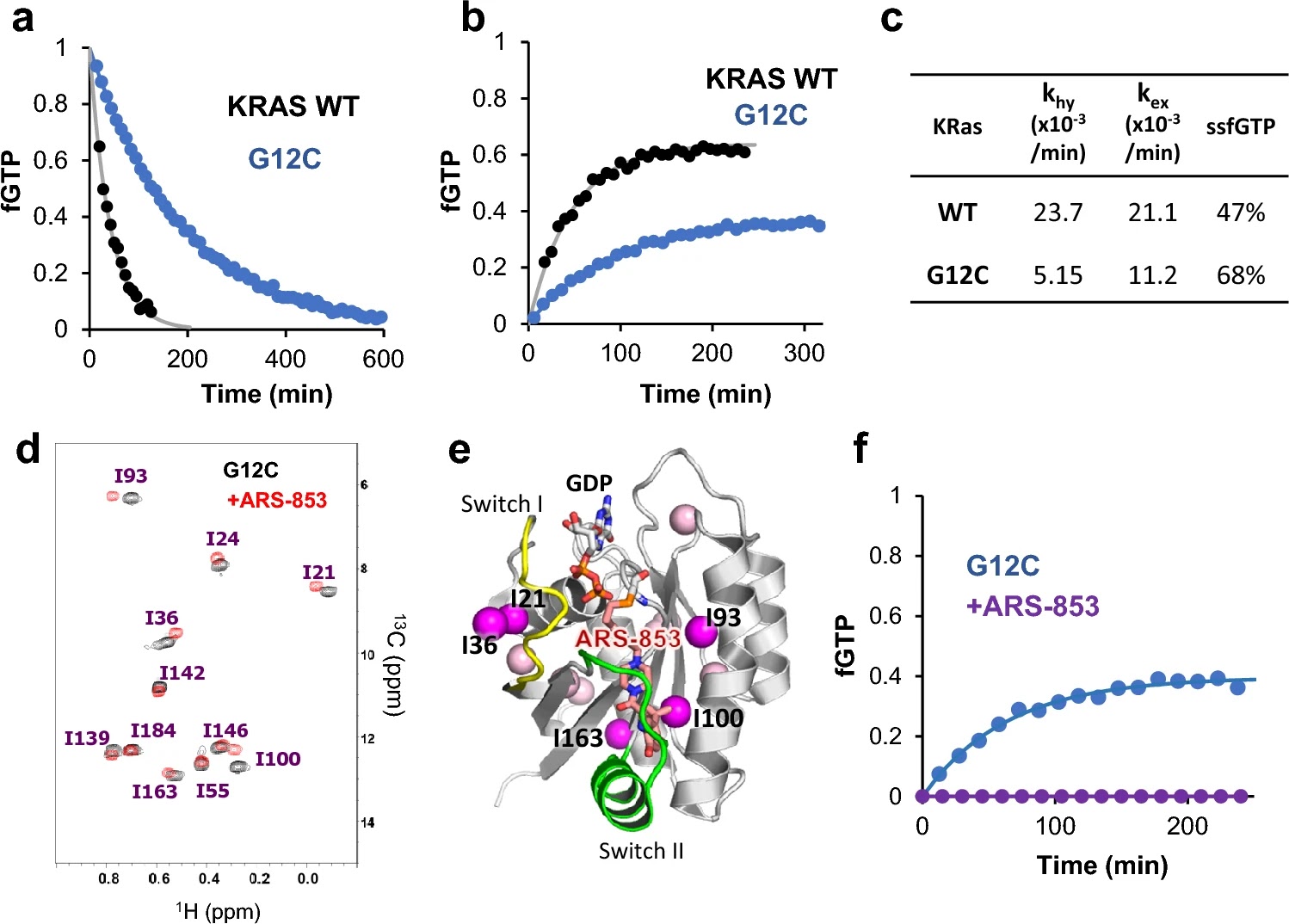
Real-time monitoring of the reaction of KRAS G12C mutant specific covalent inhibitor by in vitro and in-cell NMR spectroscopy

Qingci Zhao, Ryoka Haga, Satoko Tamura, Ichio Shimada & Noritaka Nishida 

Sci Rep 13, 19253 (2023). 

https://doi.org/10.1038/s41598-023-46623-w

KRAS mutations are major drivers of various cancers. Recently, allele-specific inhibitors of the KRAS G12C mutant were developed that covalently modify the thiol of Cys12, thereby trapping KRAS in an inactive GDP-bound state. To study the mechanism of action of the covalent inhibitors in both in vitro and intracellular environments, we used real-time NMR to simultaneously observe GTP hydrolysis and inhibitor binding. In vitro NMR experiments showed that the rate constant of ARS-853 modification is identical to that of GTP hydrolysis, indicating that GTP hydrolysis is the rate-limiting step for ARS-853 modification. In-cell NMR analysis revealed that the ARS-853 reaction proceeds significantly faster than that in vitro, reflecting acceleration of GTP hydrolysis by endogenous GTPase proteins. This study demonstrated that the KRAS covalent inhibitor is as effective in the cell as in vitro and that in-cell NMR is a valuable validation tool for assessing the pharmacological properties of the drug in the intracellular context.


Thursday, November 9, 2023

Assessing Squarates as Amine-Reactive Probes

Katherine I. Taylor, Jordan S. Ho, Hallie O. Trial, Alan W. Carter, and Laura L. Kiessling

Journal of the American Chemical Society 2023

Probes that covalently label protein targets facilitate the identification of ligand-binding sites. Lysine residues are prevalent in the proteome, making them attractive substrates for covalent probes. However, identifying electrophiles that undergo amine-specific, regioselective reactions with binding site lysine residues is challenging. Squarates can engage in two sequential conjugate addition–elimination reactions with amines. Nitrogen donation reduces the second reaction rate, making the mono squaramide a mild electrophile. We postulated that this mild electrophilicity would demand a longer residence time near the amine, affording higher selectivity for binding site lysines. Therefore, we compared the kinetics of squarate and monosquaramide amine substitution to alternative amine bioconjugation handles. The data revealed that N-hydroxy succinimidyl esters react 4 orders of magnitude faster, consistent with their labeling promiscuity. Squarate reactivity can be tuned by a substitution pattern. Electron-withdrawing groups on the vinylogous ester or amide increase reaction rates. Dithionosquarates react more rapidly than squarates, while vinylogous thioester analogs, dithiosquarates, react more slowly. We assessed squarate selectively using the UDP-sugar processing enzyme GlfT2 from Mycobacterium tuberculosis, which possesses 21 surface-exposed lysines. The reaction predominately modified one lysine proximal to a binding site to afford covalent inhibition. These findings demonstrate the selectivity of squaric esters and squaramides, which is a critical feature for affinity-based chemoproteomic probes.


Development of Covalent Inhibitors of Chikungunya Virus nsP2 Cysteine Protease Enabled by Direct-to-Biology Synthesis and Screening D

Zhengjun Cai § ; Kan Li § ; Sainetra Sridhar; Haozhou Tan; Hiwot Demssie; Gaungjin Fan; Wenyi Zhang; Bobby Brooke Herrera; Jun Wang J. Med. ...