Daniela Angst, François Gessier, Philipp Janser, Anna Vulpetti, Rudolf Wälchli, Christian Beerli, Amanda Littlewood-Evans, Janet Dawson, Barbara Nuesslein-Hildesheim, Grazyna Wieczorek, Sascha Gutmann, Clemens Scheufler, Alexandra Hinniger, Alfred Gilbert Zimmerlin, Enrico G. Funhoff, Robert Pulz, and Bruno Cenni
J. Med. Chem. 2020
https://doi.org/10.1021/acs.jmedchem.9b01916
Bruton’s tyrosine kinase (BTK), a cytoplasmic tyrosine kinase, plays a central role in immunity and is considered an attractive target for treating autoimmune diseases. The use of currently marketed covalent BTK inhibitors is limited to oncology indications based on their suboptimal kinase selectivity. We describe the discovery and preclinical profile of LOU064 (remibrutinib, 25), a potent, highly selective covalent BTK inhibitor. LOU064 exhibits an exquisite kinase selectivity due to binding to an inactive conformation of BTK and has the potential for a best-in-class covalent BTK inhibitor for the treatment of autoimmune diseases. It demonstrates potent in vivo target occupancy with an EC90 of 1.6 mg/kg and dose-dependent efficacy in rat collagen-induced arthritis. LOU064 is currently being tested in Phase 2 clinical studies for chronic spontaneous urticaria and Sjoegren’s Syndrome.
A blog highlighting recent publications in the area of covalent modification of proteins, particularly relating to covalent-modifier drugs. @CovalentMod on Twitter, @covalentmod@mstdn.science on Mastodon, and @covalentmod.bsky.social on BlueSky
Tuesday, February 25, 2020
Thursday, February 20, 2020
Designing Chimeric Molecules for Drug Discovery by Leveraging Chemical Biology
Chiara Borsari, Darci J. Trader, Annalisa Tait, and Maria P. Costi
Journal of Medicinal Chemistry 2020
DOI: 10.1021/acs.jmedchem.9b01456
Journal of Medicinal Chemistry 2020
DOI: 10.1021/acs.jmedchem.9b01456
After the first seed concept introduced in the 18th century, different disciplines have attributed different names to dual-functional molecules depending on their application, including bioconjugates, bifunctional compounds, multitargeting molecules, chimeras, hybrids, engineered compounds. However, these engineered constructs share a general structure: a first component that targets a specific cell and a second component that exerts the pharmacological activity. A stable or cleavable linker connects the two modules of a chimera. Herein, we discuss the recent advances in the rapidly expanding field of chimeric molecules leveraging chemical biology concepts. This Perspective is focused on bifunctional compounds in which one component is a lead compound or a drug. In detail, we discuss chemical features of chimeric molecules and their use for targeted delivery and for target engagement studies.
Monday, February 10, 2020
Development of a covalent inhibitor of gut bacterial bile salt hydrolases
Arijit A. Adhikari, Tom C. M. Seegar, Scott B. Ficarro, Megan D. McCurry, Deepti Ramachandran, Lina Yao, Snehal N. Chaudhari, Sula Ndousse-Fetter, Alexander S. Banks, Jarrod A. Marto, Stephen C. Blacklow & A. Sloan Devlin
Nature Chemical Biology (2020)
https://doi.org/10.1038/s41589-020-0467-3
Bile salt hydrolase (BSH) enzymes are widely expressed by human gut bacteria and catalyze the gateway reaction leading to secondary bile acid formation. Bile acids regulate key metabolic and immune processes by binding to host receptors. There is an unmet need for a potent tool to inhibit BSHs across all gut bacteria to study the effects of bile acids on host physiology. Here, we report the development of a covalent pan-inhibitor of gut bacterial BSHs. From a rationally designed candidate library, we identified a lead compound bearing an alpha-fluoromethyl ketone warhead that modifies BSH at the catalytic cysteine residue. This inhibitor abolished BSH activity in conventional mouse feces. Mice gavaged with a single dose of this compound displayed decreased BSH activity and decreased deconjugated bile acid levels in feces. Our studies demonstrate the potential of a covalent BSH inhibitor to modulate bile acid composition in vivo.
Sunday, February 2, 2020
Cyclization Reaction-Based Turn-on Probe for Covalent Labeling of Target Proteins
Simon A. Hawley, Fiona A. Ross, Fiona M. Russell, Abdelmadjid Atrih, Douglas J. Lamont, D. Grahame Hardie
Cell Chem. Biol. 2020
DOI: https://doi.org/10.1016/j.chembiol.2020.01.006
Cordycepin (3-deoxyadenosine) is a major bioactive agent in Cordyceps militaris, a fungus used in traditional Chinese medicine. It has been proposed to have many beneficial metabolic effects by activating AMP-activated protein kinase (AMPK), but the mechanism of activation remained uncertain. We report that cordycepin enters cells via adenosine transporters and is converted by cellular metabolism into mono-, di-, and triphosphates, which at high cordycepin concentrations can almost replace cellular adenine nucleotides. AMPK activation by cordycepin in intact cells correlates with the content of cordycepin monophosphate and not other cordycepin or adenine nucleotides. Genetic knockout of AMPK sensitizes cells to the cytotoxic effects of cordycepin. In cell-free assays, cordycepin monophosphate mimics all three effects of AMP on AMPK, while activation in cells is blocked by a γ-subunit mutation that prevents activation by AMP. Thus, cordycepin is a pro-drug that activates AMPK by being converted by cellular metabolism into the AMP analog cordycepin
monophosphate.
.
Saturday, January 25, 2020
The clinical KRAS(G12C) inhibitor AMG 510 drives anti-tumour immunity
Jude Canon, Karen Rex, Anne Y. Saiki, Christopher Mohr, Keegan Cooke, Dhanashri Bagal,
Kevin Gaida, Tyler Holt, Charles G. Knutson, Neelima Koppada, Brian A. Lanman, Jonathan
Werner, Aaron S. Rapaport, Tisha San Miguel, Roberto Ortiz, Tao Osgood, Ji-Rong Sun,
Xiaochun Zhu, John D. McCarter, Laurie P. Volak, Brett E. Houk, Marwan G. Fakih, Bert H.
O’Neil, Timothy J. Price, Gerald S. Falchook, Jayesh Desai, James Kuo, Ramaswamy Govindan, David S. Hong, Wenjun Ouyang, Haby Henary, Tara Arvedson, Victor J. Cee & J. Russell Lipford
Nature 575, 217–223 (2019).
DOI: https://doi.org/10.1038/s41586-019-1694-1
KRAS is the most frequently mutated oncogene in cancer and encodes a key signalling protein in tumours. The KRAS(G12C) mutant has a cysteine residue that has been exploited to design covalent inhibitors that have promising preclinical activity. Here we optimized a series of inhibitors, using novel binding interactions to markedly enhance their potency and selectivity. Our efforts have led to the discovery of AMG 510, which is, to our knowledge, the first KRAS(G12C) inhibitor in clinical development. In preclinical analyses, treatment with AMG 510 led to the regression of KRASG12C tumours and improved the anti-tumour efficacy of chemotherapy and targeted agents. In immune-competent mice, treatment with AMG 510 resulted in a pro-inflammatory tumour microenvironment and produced durable cures alone as well as in combination with immune-checkpoint inhibitors. Cured mice rejected the growth of isogenic KRASG12D tumours, which suggests adaptive immunity against shared antigens. Furthermore, in clinical trials, AMG 510 demonstrated anti-tumour activity in the first dosing cohorts and represents a potentially transformative therapy for patients for whom effective treatments are lacking.
Monday, January 20, 2020
Structure-based design of a potent and selective covalent inhibitor for SRC kinase that targets a p-Loop cysteine
Guangyan Du, Suman Rao, Deepak Gurbani,
Nathaniel J. Henning, Jie Jiang, Jianwei Che, Annan Yang, Scott B Ficarro,
Jarrod A. Marto, Andrew J. Aguirre, Peter K. Sorger, Kenneth Dale Westover,
Tinghu Zhang, and Nathanael S Gray.
J. Med. Chem. 2020.DOI: https://doi.org/10.1021/acs.jmedchem.9b01502
SRC is a major regulator of many
signaling pathways and contributes to cancer development. However, development
of a selective SRC inhibitor has been challenging, and FDA-approved SRC
inhibitors, dasatinib and bosutinib, are multitargeted kinase inhibitors. Here,
we describe our efforts to develop a selective SRC covalent inhibitor by
targeting cysteine 277 on the P loop of SRC. Using a promiscuous covalent
kinase inhibitor (CKI) SM1-71 as a starting point we developed covalent
inhibitor 15a, which discriminates SRC from other covalent targets of SM1-71
including TAK1 and FGFR1. As an irreversible covalent inhibitor, compound 15a
exhibited sustained inhibition of SRC signaling both in vitro and in vivo.
Moreover, 15a exhibited potent anti-proliferative effects in non-small cell
lung cancer cell lines harboring SRC activation, thus providing evidence that
this approach may be promising for further drug development efforts.
Saturday, January 11, 2020
Structure-based design and analysis of SuFEx chemical probes
Lyn H. Jones and Jeffery W. Kelly
RSC Med. Chem., 2020
DOI: 10.1039/C9MD00542K
RSC Med. Chem., 2020
DOI: 10.1039/C9MD00542K
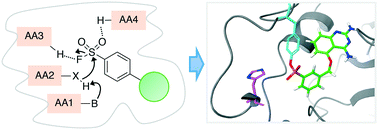
The discerning reactivity of sulfur(VI)-fluoride exchange (SuFEx) chemistry has enabled the context-specific labeling of protein binding sites by chemical probes that incorporate these versatile warheads. Emerging information from protein-probe structures and proteomic mapping experiments is helping advance our understanding of the protein microenvironment that dictates the reactivity of targetable amino acid residues. This review explores these new findings that should influence the future rational design of SuFEx probes for a multitude of applications in chemical biology and drug discovery.
Subscribe to:
Posts (Atom)
Covalent-Allosteric Akt Inhibitors: Targeting Akt3 through Molecular Hybridization and Expanding the Isoform-Selective Toolbox
Kosmas Alexandros Pervanidis § ; Giovanni Danilo D’Angelo § ; Ioannis Athanasiadis § ; Hannah Jantzen; Andrea Scrima; Katharina Schäfer; Len...
-
Xu-liang Xu, Ti-ti Ying, Xiao-wen Wu, Yun-jun Chen, Gang-ao Hu, Yu-tian Guan, Shi-yi Liu, He Wang, Mohamed Seif, Mahmoud Emam, Hong Wang, We...
-
Joseph E Klebba, Nilotpal Roy, Steffen M Bernard, Stephanie Grabow, Melissa A. Hoffman, Hui Miao, Junko Tamiya, Jinwei Wang, Cynthia Berry, ...
-
Ran Cheng, Hanfeng Lin, Xin Yu, Shrilekha Misra, Andrew D. Mitchell, Jennifer A. Woyach, Xiaoli Qi & Jin Wang Nat Commun (2026). https:...