Khuchtumur Bum-Erdene, Degang Liu, Giovanni Gonzalez-Gutierrez, Mona K. Ghozayel, David Xu, Samy O. Meroueh
Proceedings of the National Academy of Science, 2020, 201913654;
DOI: 10.1073/pnas.1913654117
Ral (Ras-like) GTPases are directly activated by oncogenic Ras GTPases. Mutant K-Ras (G12C) has enabled the development of covalent K-Ras inhibitors currently in clinical trials. However, Ral, and the overwhelming majority of mutant oncogenic K-Ras, are devoid of a druggable pocket and lack an accessible cysteine for the development of a covalent inhibitor. Here, we report that covalent bond formation by an aryl sulfonyl fluoride electrophile at a tyrosine residue (Tyr-82) inhibits guanine exchange factor Rgl2-mediated nucleotide exchange of Ral GTPase. A high-resolution 1.18-Å X-ray cocrystal structure shows that the compound binds to a well-defined binding site in RalA as a result of a switch II loop conformational change. The structure, along with additional high-resolution crystal structures of several analogs in complex with RalA, confirm the importance of key hydrogen bond anchors between compound sulfone oxygen atoms and Ral backbone nitrogen atoms. Our discovery of a pocket with features found on known druggable sites and covalent modification of a bystander tyrosine residue present in Ral and Ras GTPases provide a strategy that could lead to therapeutic agent targeting oncogenic Ras mutants that are devoid of a cysteine nucleophile.
Thursday, March 19, 2020
Tuesday, March 17, 2020
CM93, a novel covalent small molecule inhibitor targeting lung cancer with mutant EGFR
Qiwei Wang, Jing Ni, Tao Jiang, Hwan Geun Choi, Tinghu Zhang, Nathanael Gray, Jean J. Zhao
BioRXiv, 2020
doi: https://doi.org/10.1101/2020.03.09.984500
Epidermal growth factor receptor (EGFR) tyrosine kinase inhibitors (TKIs) have provided successful targeted therapies for patients with EGFR-mutant non-small-cell lung cancer (NSCLC). Osimertinib (AZD9291) is a third-generation irreversible EGFR TKI that has received regulatory approval for overcoming resistance mediated by the EGFR T790M mutation as well as a first-line treatment targeting EGFR activating mutations. However, a significant fraction of patients cannot tolerate the adverse effect associated with AZD9291. In addition, brain metastases are common in patients with NSCLN and remain a major clinical challenge. Here, we report the development of a novel third-generation EGFR TKI, CM93. Compared to AZD9291, CM93 exhibits improved lung cancer targeting and brain penetration and has demonstrated promising antitumor efficacy in mouse models of both EGFR-mutant NSCLC orthotopic and brain metastases. In addition, we find that CM93 confers superior safety benefits in mice. Our results demonstrate that further evaluations of CM93 in clinical studies for patients with EGFR-mutant NSCLC and brain metastases are warranted.
BioRXiv, 2020
doi: https://doi.org/10.1101/2020.03.09.984500
Epidermal growth factor receptor (EGFR) tyrosine kinase inhibitors (TKIs) have provided successful targeted therapies for patients with EGFR-mutant non-small-cell lung cancer (NSCLC). Osimertinib (AZD9291) is a third-generation irreversible EGFR TKI that has received regulatory approval for overcoming resistance mediated by the EGFR T790M mutation as well as a first-line treatment targeting EGFR activating mutations. However, a significant fraction of patients cannot tolerate the adverse effect associated with AZD9291. In addition, brain metastases are common in patients with NSCLN and remain a major clinical challenge. Here, we report the development of a novel third-generation EGFR TKI, CM93. Compared to AZD9291, CM93 exhibits improved lung cancer targeting and brain penetration and has demonstrated promising antitumor efficacy in mouse models of both EGFR-mutant NSCLC orthotopic and brain metastases. In addition, we find that CM93 confers superior safety benefits in mice. Our results demonstrate that further evaluations of CM93 in clinical studies for patients with EGFR-mutant NSCLC and brain metastases are warranted.

Friday, March 6, 2020
Discovery of Lysine-Targeted eIF4E Inhibitors through Covalent Docking
Xiaobo Wan, Tangpo Yang, Adolfo Cuesta, Xiaming Pang, Trent E. Balius, John J. Irwin, Brian K. Shoichet, and Jack Taunton
J. Am. Chem. Soc. 2020
doi: 10.1021/jacs.9b10377
Eukaryotic translation initiation factor 4E (eIF4E) binds the m7GTP cap structure at the 5′-end of mRNAs, stimulating the translation of proteins implicated in cancer cell growth and metastasis. eIF4E is a notoriously challenging target, and most of the reported inhibitors are negatively charged guanine analogues with negligible cell permeability. To overcome these challenges, we envisioned a covalent targeting strategy. As there are no cysteines near the eIF4E cap binding site, we developed a covalent docking approach focused on lysine. Taking advantage of a “make-on-demand” virtual library, we used covalent docking to identify arylsulfonyl fluorides that target a noncatalytic lysine (Lys162) in eIF4E. Guided by cocrystal structures, we elaborated arylsulfonyl fluoride 2 to 12, which to our knowledge is the first covalent eIF4E inhibitor with cellular activity. In addition to providing a new tool for acutely inactivating eIF4E in cells, our computational approach may offer a general strategy for developing selective lysine-targeted covalent ligands.

J. Am. Chem. Soc. 2020
doi: 10.1021/jacs.9b10377
Eukaryotic translation initiation factor 4E (eIF4E) binds the m7GTP cap structure at the 5′-end of mRNAs, stimulating the translation of proteins implicated in cancer cell growth and metastasis. eIF4E is a notoriously challenging target, and most of the reported inhibitors are negatively charged guanine analogues with negligible cell permeability. To overcome these challenges, we envisioned a covalent targeting strategy. As there are no cysteines near the eIF4E cap binding site, we developed a covalent docking approach focused on lysine. Taking advantage of a “make-on-demand” virtual library, we used covalent docking to identify arylsulfonyl fluorides that target a noncatalytic lysine (Lys162) in eIF4E. Guided by cocrystal structures, we elaborated arylsulfonyl fluoride 2 to 12, which to our knowledge is the first covalent eIF4E inhibitor with cellular activity. In addition to providing a new tool for acutely inactivating eIF4E in cells, our computational approach may offer a general strategy for developing selective lysine-targeted covalent ligands.

Wednesday, March 4, 2020
Targeting the PI5P4K Lipid Kinase Family in Cancer Using Covalent Inhibitors
Sindhu Carmen Sivakumaren, Hyeseok Shim, Tinghu Zhang, Fleur M. Ferguson, Mark R. Lundquist,
Christopher M. Browne, Hyuk-Soo Seo, Marcia N. Paddock, Theresa D. Manz, Baishan Jiang, Ming-Feng Hao, Pranav Krishnan, Diana G. Wang, T. Jonathan Yang, Nicholas P. Kwiatkowski, Scott B. Ficarro, James M. Cunningham, Jarrod A. Marto, Sirano Dhe-Paganon, Lewis C. Cantley, Nathanael S. Gray
Cell Chemical Biology, 2020
The PI5P4Ks have been demonstrated to be important for cancer cell proliferation and other diseases. However, the therapeutic potential of targeting these kinases is understudied due to a lack of potent, specific small molecules available. Here, we present the discovery and characterization of a pan-PI5P4K inhibitor, THZ-P1-2, that covalently targets cysteines on a disordered loop in PI5P4Kα/β/γ. THZ-P1-2 demonstrates cellular on-target engagement with limited off-targets across the kinome. AML/ALL cell lines were sensitive to THZ-P1-2, consistent with PI5P4K's reported role in leukemogenesis. THZ-P1-2 causes autophagosome clearance defects and upregulation in TFEB nuclear localization and target genes, disrupting autophagy in a covalent-dependent manner and phenocopying the effects of PI5P4K genetic deletion. Our studies demonstrate that PI5P4Ks are tractable targets, with THZ-P1-2 as a useful tool to further interrogate the therapeutic potential of PI5P4K inhibition and inform drug discovery campaigns for these lipid kinases in cancer metabolism and other autophagy-dependent disorders.

Covalent Small Molecules as Enabling Platforms for Drug Discovery
Dalton, S.E. and Campos, S.
ChemBioChem, 2020
doi: 10.1002/cbic.201900674
Covalent drugs have experienced significant renewed interest in drug discovery. This resurgence has been accompanied by a better understanding of the reactivity relationships required to engage selective covalent bonds between nucleophilic proteins and electrophilic small molecules. As a result, researchers have come to the realisation that covalent molecules could also represent useful and novel tools aimed at supporting medicinal chemistry programmes. This review surveys the increasing number of drug discovery platforms employing covalent chemistries, and highlights the utility of these techniques for identifying and characterising small molecules and biological targets.

ChemBioChem, 2020
doi: 10.1002/cbic.201900674
Covalent drugs have experienced significant renewed interest in drug discovery. This resurgence has been accompanied by a better understanding of the reactivity relationships required to engage selective covalent bonds between nucleophilic proteins and electrophilic small molecules. As a result, researchers have come to the realisation that covalent molecules could also represent useful and novel tools aimed at supporting medicinal chemistry programmes. This review surveys the increasing number of drug discovery platforms employing covalent chemistries, and highlights the utility of these techniques for identifying and characterising small molecules and biological targets.

Monday, March 2, 2020
Systematic identification of engineered methionines and oxaziridines for efficient, stable, and site-specific antibody bioconjugation [@Toste_Group, @christhechang
Susanna K. Elledge, Hai L. Tran, Alec H. Christian, Veronica Steri, Byron Hann, F. Dean Toste, Christopher J. Chang, James A. Wells
Proceedings of the National Academy of Sciences 2020
DOI: 10.1073/pnas.1920561117
Site-specific chemical modification of proteins remains a critical need for bioconjugation. Here we explore the key parameters needed for efficient, selective, and stable modification of methionine using recently developed oxaziridine reagents, called ReACT. We systematically tested various oxaziridine compounds, and scanned accessible and buried sites in a therapeutic antibody for breast cancer to determine the chemical and structural parameters for most stable and efficient modification. We show these adducts are highly stable over days and can support the delivery of toxic payloads to regress tumors in animals. These studies on this important chemical modification expand our capability to site-specifically modify proteins and antibodies for many applications.

Proceedings of the National Academy of Sciences 2020
DOI: 10.1073/pnas.1920561117
Site-specific chemical modification of proteins remains a critical need for bioconjugation. Here we explore the key parameters needed for efficient, selective, and stable modification of methionine using recently developed oxaziridine reagents, called ReACT. We systematically tested various oxaziridine compounds, and scanned accessible and buried sites in a therapeutic antibody for breast cancer to determine the chemical and structural parameters for most stable and efficient modification. We show these adducts are highly stable over days and can support the delivery of toxic payloads to regress tumors in animals. These studies on this important chemical modification expand our capability to site-specifically modify proteins and antibodies for many applications.

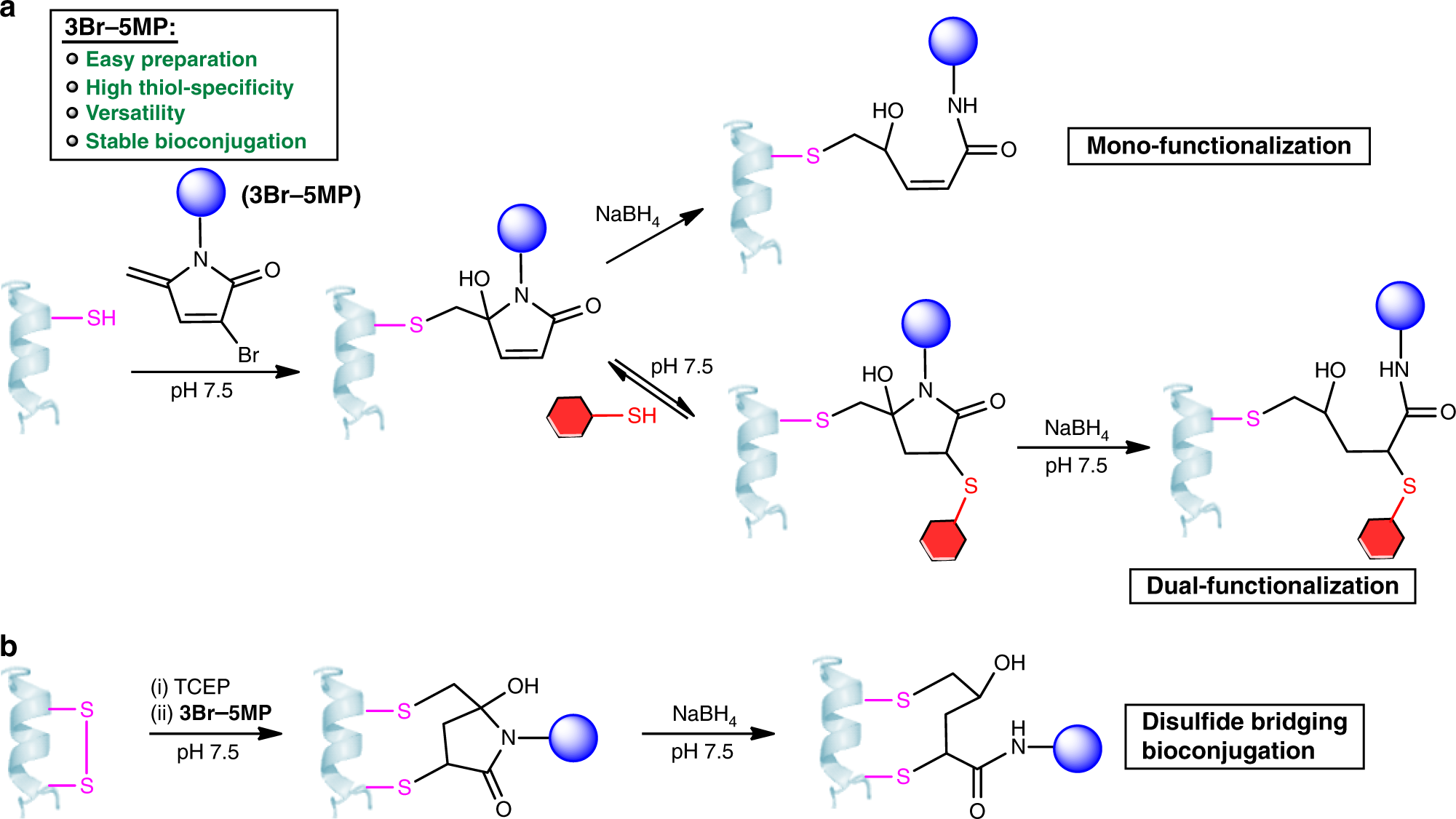
Cysteine-specific protein multi-functionalization and disulfide bridging using 3-bromo-5-methylene pyrrolones
Yingqian Zhang, Chuanlong Zang, Guoce An, Mengdi Shang, Zenghui Cui, Gong Chen, Zhen Xi & Chuanzheng Zhou
Nature Communications 2020
DOI: 10.1038/s41467-020-14757-4
Many reagents have been developed for cysteine-specific protein modification. However, few of them allow for multi-functionalization of a single Cys residue and disulfide bridging bioconjugation. Herein, we report 3-bromo-5-methylene pyrrolones (3Br-5MPs) as a simple, robust, and versatile class of reagents for cysteine-specific protein modification. These compounds can be facilely synthesized via a one-pot mild reaction and they show comparable tagging efficiency but higher cysteine specificity than the maleimide counterparts. The addition of cysteine to 3Br-5MPs generates conjugates that are amenable to secondary addition by another thiol or cysteine, making 3Br-5MPs valuable for multi-functionalization of a single cysteine and disulfide bridging bioconjugation. The labeling reaction and subsequent treatments are mild enough to produce stable and active protein conjugates for biological applications.
Nature Communications 2020
DOI: 10.1038/s41467-020-14757-4
Many reagents have been developed for cysteine-specific protein modification. However, few of them allow for multi-functionalization of a single Cys residue and disulfide bridging bioconjugation. Herein, we report 3-bromo-5-methylene pyrrolones (3Br-5MPs) as a simple, robust, and versatile class of reagents for cysteine-specific protein modification. These compounds can be facilely synthesized via a one-pot mild reaction and they show comparable tagging efficiency but higher cysteine specificity than the maleimide counterparts. The addition of cysteine to 3Br-5MPs generates conjugates that are amenable to secondary addition by another thiol or cysteine, making 3Br-5MPs valuable for multi-functionalization of a single cysteine and disulfide bridging bioconjugation. The labeling reaction and subsequent treatments are mild enough to produce stable and active protein conjugates for biological applications.
Subscribe to:
Posts (Atom)