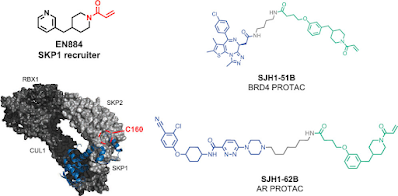
Targeted protein degradation with proteolysis targeting chimeras (PROTACs) is a powerful therapeutic modality for eliminating disease-causing proteins through targeted ubiquitination and proteasome-mediated degradation. Most PROTACs have exploited substrate receptors of Cullin-RING E3 ubiquitin ligases such as cereblon and VHL. Whether core, shared, and essential components of the Cullin-RING E3 ubiquitin ligase complex can be used for PROTAC applications remains less explored. Here, we discovered a cysteine-reactive covalent recruiter EN884 against the SKP1 adapter protein of the SKP1-CUL1-F-box containing the SCF complex. We further showed that this recruiter can be used in PROTAC applications to degrade neo-substrate proteins such as BRD4 and the androgen receptor in a SKP1- and proteasome-dependent manner. Our studies demonstrate that core and essential adapter proteins within the Cullin-RING E3 ubiquitin ligase complex can be exploited for targeted protein degradation applications and that covalent chemoproteomic strategies can enable recruiter discovery against these targets.
A blog highlighting recent publications in the area of covalent modification of proteins, particularly relating to covalent-modifier drugs. @CovalentMod on Twitter, @covalentmod@mstdn.science on Mastodon, and @covalentmod.bsky.social on BlueSky
Linking of fragments in neighboring binding sites is one of the optimization strategies in fragment-based drug discovery, where additive or even more substantial bioactivity improvements can be realized. However, such efforts present a considerable challenge when one fragment binds covalently to the target protein, as small modifications can influence the correct positioning of the covalent warhead toward the targeted nucleophilic residue. Here, we present a case study of fragment linking that yielded single-digit micromolar, covalent inhibitors of the SARS-CoV-2 main protease, starting from fragments that were inactive in the biochemical assay. Using structural information from a recent, high-throughput crystallographic fragment screen, we show that the success of fragment linking in the design of targeted covalent inhibitors is heavily impacted by several factors, including the warhead type, the labeling chemistry, and even subtle changes in the designed linker. Notably, we observe that induced fit effects might override the original fragment orientations in the linked molecule, highlighting the need for reliable structure verification, especially in consecutive rounds of fragment elaboration.
Levente Kollár, Levente M. Mihalovits, Dávid Bajusz, DamijanKnez, József Simon, Blake H. Balcomb, Daren Fearon, Stanislav Gobec, György M. K...
-
Design, synthesis and biological evaluation of the activity-based probes for FGFR covalent inhibitorDandan Zhu, Zijian Zheng, Huixin Huang, Xiaojuan Chen, Shuhong Zhang, Zhuchu Chen, Ting Liu, Guangyu Xu, Ying Fu, Yongheng Chen, European Jo...
-
DOI Ansgar Oberheide, Maxime van den Oetelaar, Jakob Scheele, Jan Borggräfe, Semmy Engelen, Michael Sattler, Christian Ottmann, ...
-
Yoav Shamir, Nir London bioRxiv 2025.03.19.642201 doi: https://doi.org/10.1101/2025.03.19.642201 Recent years have seen an explosion in the...